Lemonade stands
A stand is an NFT on TON. It records its type, city, zone, level, experience, current production cycle and repair count. It is yours: you can run it, upgrade it, move it, or sell it on the marketplace.
Stand types
Types differ in capacity: how many lemonades the stand can serve per minute during the round. Because customers per minute are random between 0 and 15 (see The daily round), capacity has strongly diminishing returns. A stand that can serve 15 per minute sells only about 2.2× what a stand serving 6 per minute sells, not 2.5×.
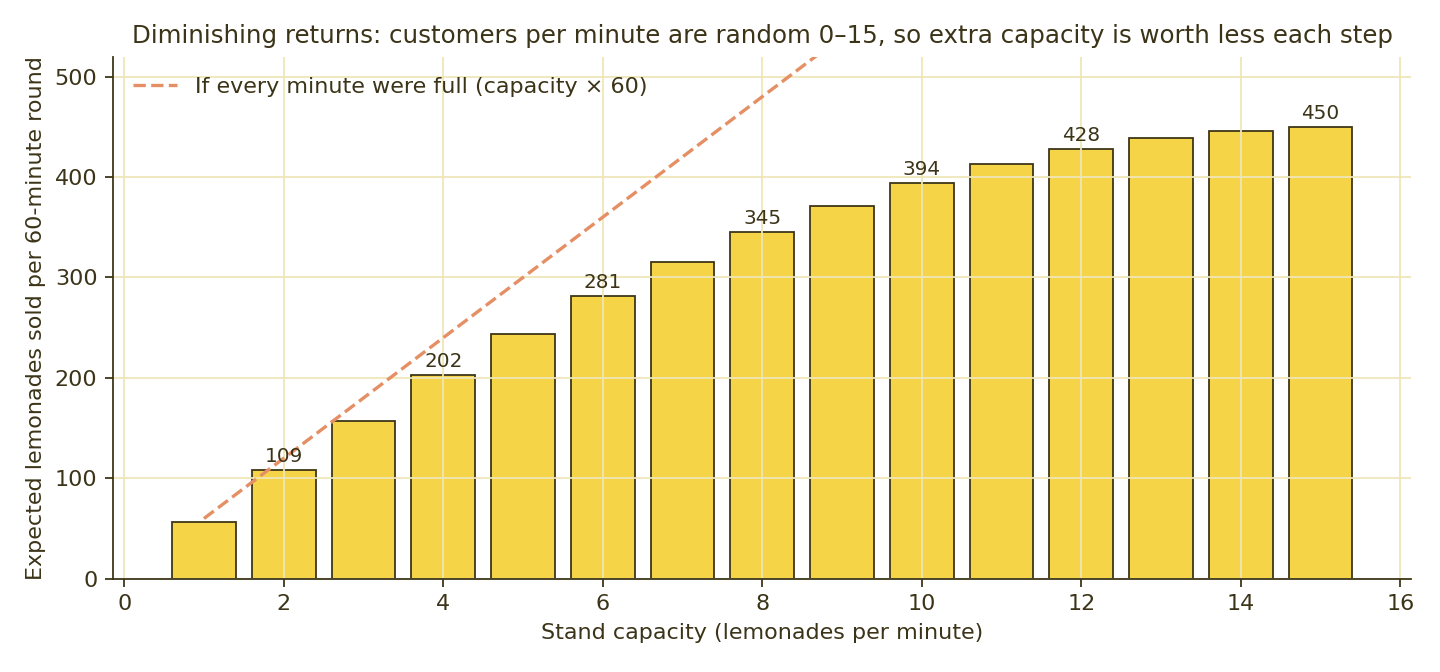
Prices scale with what a type actually sells, not with its nominal capacity. That keeps the return multiple identical across types, so a Legendary is faster and more prestigious, never more profitable per LEMON invested.
| Type | Capacity (cups/min) | Expected cups per round | Price vs. Common | Upgradeable by |
|---|---|---|---|---|
| Common | 2–6 | ~200 | ×1.00 | +6 (level & equipment) |
| Uncommon | 5–9 | ~315 | ×1.55 | +6 |
| Rare | 8–12 | ~395 | ×1.95 | +7 |
| Legendary | 10–15 | ~435 | ×2.15 | +8 |
Types are found in stand boxes; the Common stand can also be bought directly.
The price ladder
The price of a Common stand is fixed in LEMON and depends only on how many stands have ever been sold. It never depends on the LEMON/GRAM (ExTON) price. Early players pay less, and the ladder flattens so the game stays affordable to join.
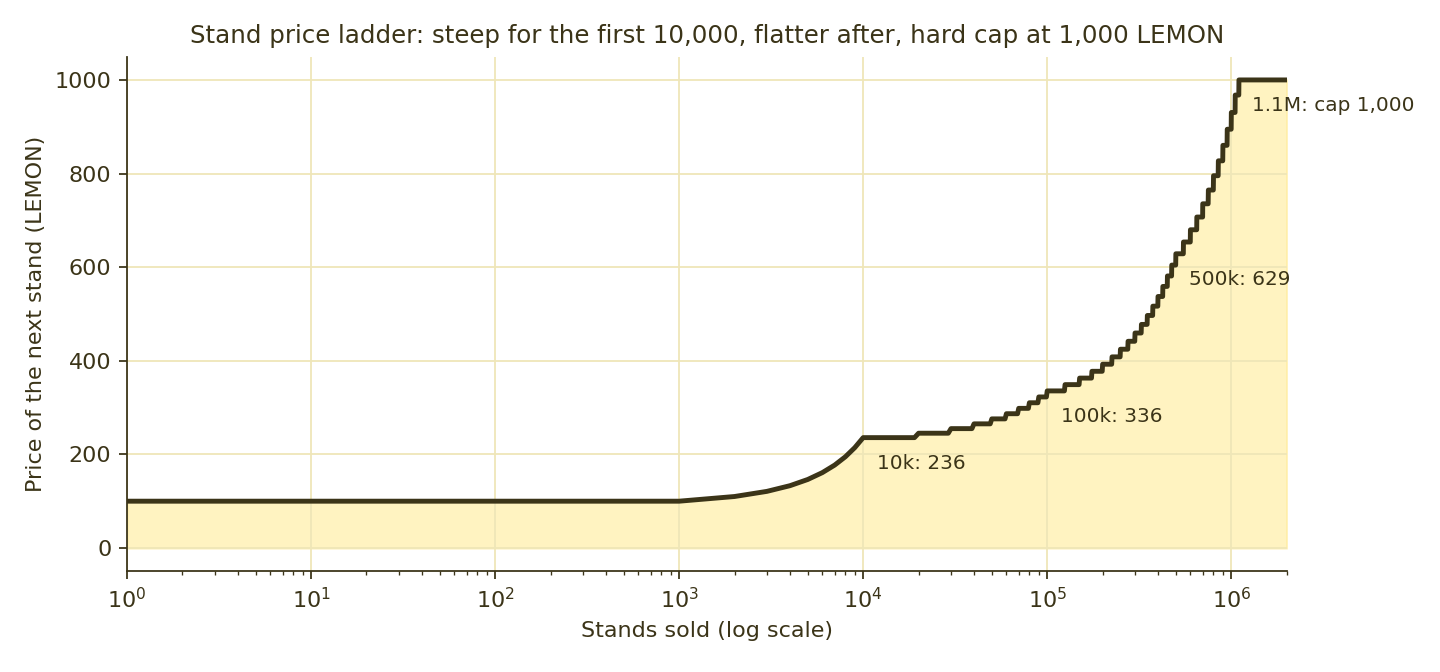
| Phase | Stands sold | Step | Price at end of phase |
|---|---|---|---|
| 1 | 1 – 10,000 | +10% every 1,000 | 236 LEMON |
| 2 | 10,001 – 100,000 | +4% every 10,000 | 336 LEMON |
| 3 | 100,001 – 500,000 | +4% every 25,000 | 629 LEMON |
| 4 | 500,001 + | +4% every 50,000 | hard cap 1,000 LEMON (reached around stand 1.1M) |
At the price band ceiling of 0.15 GRAM per LEMON, that is 15 GRAM for the first stand and never more than 150 GRAM for any Common stand, ever.
Stands per account. Until the 10,000th stand is sold, each account can run at most 3 stands; after that, 10. There is no per-account surcharge — the ladder itself is what charges every later stand more. Accounts are tied to a Telegram identity. For what comes after ten stands, see the production-assets roadmap.
The price index
Every price in SEED — cups, supplies, equipment, taxes — is multiplied by the price index: the current Common ladder price divided by 100. At launch the index is 1.0; when the ladder reaches 236 LEMON the index is 2.36 and every SEED price in the game is 2.36× its launch value. One price list, for everyone, at all times. Three things follow:
- Every stand pays back at the same speed. A stand's cap is fixed in LEMON when its cycle starts, but its daily sales are priced at today's index. A 600-LEMON stand sells at 6× launch prices and reaches its cap as fast as a 100-LEMON stand ever did — and stands bought when the ladder was cheap, whose caps are small in today's terms, finish their cycles faster than anyone. Being early keeps its reward.
- SEED never lose value in LEMON. The 100 SEED → 1 LEMON rate does not move. What rises are prices in SEED, so SEED left idle buy less tomorrow than today. Spend them or redeem them; the index is why hoarding SEED is not a strategy.
- Repairs close the edge gently. A major repair costs 50% of the average of what you paid and the current ladder price, so an early stand repairs cheaper than a new one buys — the early advantage fades a little with each repair instead of being confiscated.
Production cycles: how much a stand earns
Run averagely, a stand's whole eleven-month life (purchase plus its four repairs) ends about +90% up; run well, close to +188%. The cap that produces those numbers is known before you buy. Every stand earns in cycles. A cycle ends when the stand's gross SEED sales reach a fixed multiple of what you paid for that cycle.
| Cycle | You pay | Gross cap | Net you keep after supplies (≈40% of gross) |
|---|---|---|---|
| Purchase | 100% of stand price | 200% | ≈120% |
| Repair 1 | 50% of the average of your price and the current price | 210% | ≈126% |
| Repair 2 | same | 220% | ≈132% |
| Repair 3 | same | 230% | ≈138% |
| Repair 4 | same | 240% | ≈144% |
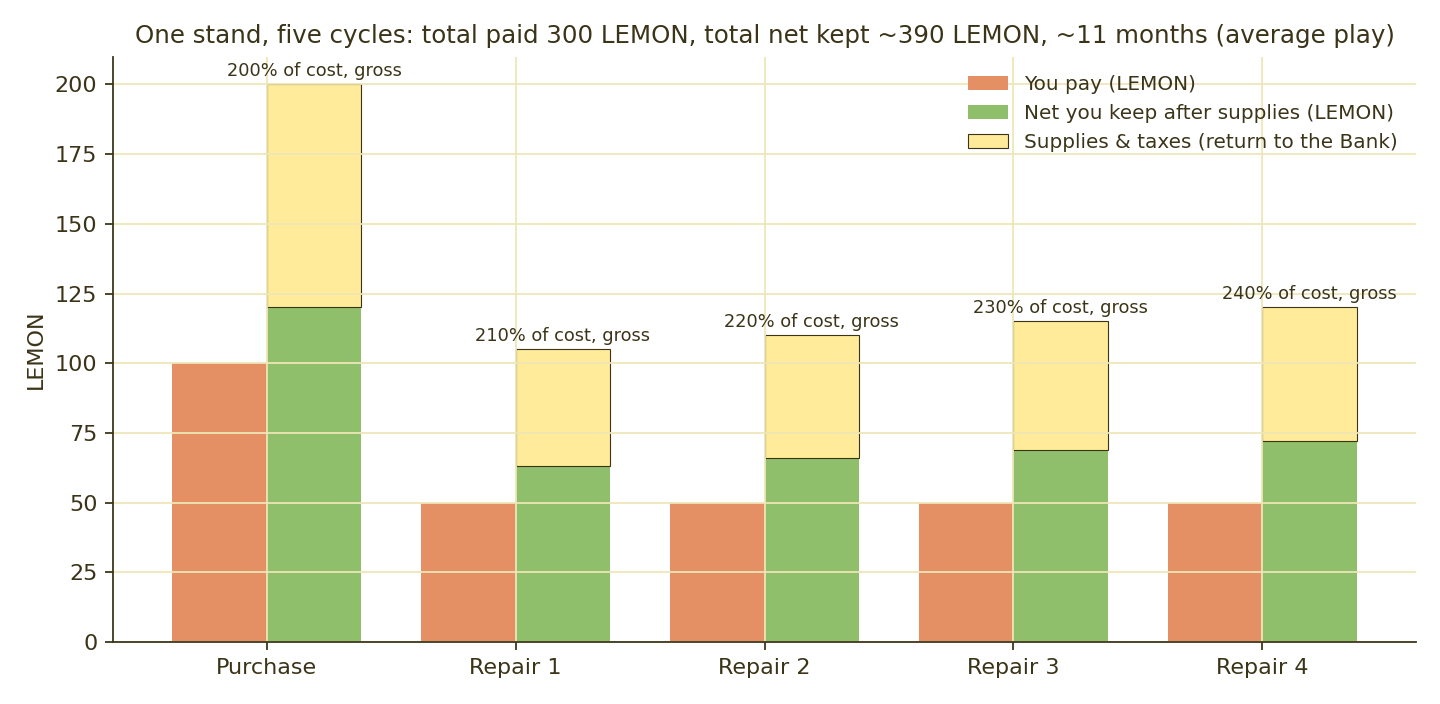
Worked example at constant prices for a 100-LEMON stand: the first cycle takes about 120 days, each repair cycle about two months (levels speed them up), so the whole life — purchase plus four repairs — is roughly 11 months of daily play. You pay 300 LEMON in across the five cycles, but the repairs are paid out of earnings along the way, so the first 100 LEMON is the only capital you ever put in. The gross cap over the life is 650 LEMON; what you keep depends entirely on how you operate, because the cap is on gross and supplies come out of it:
| Operator | Supplies | Net kept over the life | Outcome on the first 100 LEMON |
|---|---|---|---|
| Lazy — max everything, ignores the weather | ≈55% of gross | ≈293 LEMON | ≈ −8% |
| Average | ≈40% of gross | ≈390 LEMON | ≈ +90% |
| Good — tuned formula, ≈5% tips | ≈30% of gross | ≈488 LEMON | ≈ +188% |
These are the current balance targets and will be tuned during the beta. The spread is the point: skill is the only lever that changes your multiple, and a neglected stand can end below water. One more honest number: a player who never repairs gets only the first cycle — about +20% net in roughly four months — and the stand then sits idle until it is repaired.
Why put a cap on a winning trade at all? Because the +90% is only ever payable because it is capped: the cap is the one thing that lets the Bank promise it will always be able to pay. See Tokenomics.
Major repairs
When a cycle ends, the stand stops until you pay for a major repair. The repair costs 50% of the average of what you originally paid and the current ladder price, so early buyers keep an advantage without ever getting a free perpetual stand. Each repair raises the next cap by 10 points and raises the stand's level by one (+10% production speed). After the fourth repair the stand retires.
Retirement
A retired stand keeps its level, experience and history. Two things make retirement worth reaching:
- Inheritance. When you buy a new stand, you can attach one retired stand to it. The new stand starts at the retired stand's level.
- Collector bonus. Every retired stand you hold gives −2% on daily supply prices, up to −10%.
Marketplace
Stands can be listed and sold for LEMON. A 5% fee goes to the Bank. What a buyer is paying for is precise and visible on the listing: type, city, zone, level, repairs remaining, how much of the current cycle's cap is still unproduced, and the price originally paid — which matters because it sets the remaining repair costs. A stand bought when the ladder was cheap repairs cheaper than a new stand costs, and that is part of its premium. High-level stands cycle faster, so they carry a real premium; stands near the end of a cycle carry a discount. There is nothing hidden.