Tokenomics
LEMON is a jetton on the TON blockchain. Supply cap: 100,000,000 LEMON. Nothing in this document is a target we hope to hit; each item is a rule enforced by a contract, and the section at the end lists which contract enforces what.
Supply: the team holds no tokens
There is no team allocation, no presale, no marketing bucket in LEMON. 100% of the supply is minted only by the Bank, only against demand, and only inside the bounds below. Every LEMON that exists is either in the DEX pool, in the Bank, or in a player's hands. The team is paid in GRAM (ExTON), and only when the game sells.
The initial liquidity pool is seeded by the team with 5,000 GRAM against 100,000 LEMON (price 0.05, the floor of the band). The LP tokens are locked for 24 months, then returned to the team; the liquidity the reserve adds afterwards is permanent.
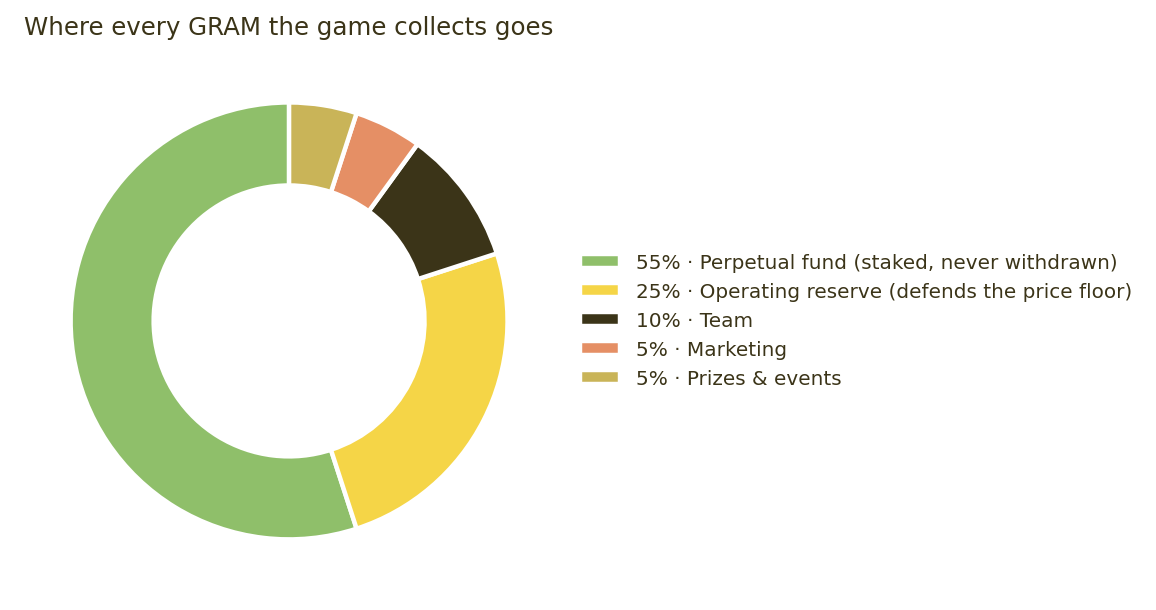
Where every GRAM goes
Every GRAM the game collects, whether from selling LEMON at the ceiling, from direct in-app LEMON purchases, or from GRAM-priced content such as cosmetics and season passes, is split the same way at the moment it arrives:
| Share | Goes to | What it does |
|---|---|---|
| 55% | Perpetual fund | Staked. Principal never leaves. Daily yield: 10% team; at or above the band floor, 20% recapitalises the fund and 70% buys & burns; below the floor, 90% buys & burns. |
| 25% | Operating reserve | Defends the price floor and deepens liquidity. 80% in liquid staking with instant unstake, 20% kept as plain GRAM. Yield: 50% team, 50% stays in the reserve. If the reserve falls below six months of floor defence, its share rises to 40% until it recovers. |
| 10% | Team | The team's income. Paid only when the game sells. |
| 5% | Marketing | |
| 5% | Prizes & events | Tournaments, city events, seasonal rewards. Never used for base production. |
Three consequences worth saying out loud. First, the team earns nothing from the LEMON players spend on stands: that LEMON goes entirely to the Bank that pays rewards. Second, the team earns only when someone wants LEMON badly enough to buy it above the ceiling, which is the same moment the fund and the reserve grow. Third, because the fund and the reserve are staked, the team's income is tied for as long as the game exists to how large those two balances are, and the only way to make them large is to sell more stands to more players.
The three contracts you should care about
1. The Bank
The Bank is the game contract that holds LEMON and pays SEED redemptions. Its rules:
- It receives every LEMON spent on stands, repairs, zone upgrades and marketplace fees. All of it.
- It pays redemptions at up to 100 SEED per LEMON, from what it holds.
- For the player, a stand's eleven-month life (purchase plus its four repairs) ends about +90% up on average — the cap is a cap on profit, not a haircut. That production is capped per cycle (200% of gross, see Stands), and supplies and taxes return ~40% of gross before anything is redeemed. So for every 100 LEMON the Bank receives, the most it can ever owe is 120, and only if players redeem every last SEED and buy nothing optional.
- If a month's redemptions exceed what it holds, it may mint up to 20% of that month's redemptions (never beyond the supply cap), and may ask the operating reserve to buy LEMON back from the market. Anything still uncovered scales that month's rate down for everyone, proportionally.
The Bank cannot mint to pay a specific player, cannot pay above 100:1, cannot send LEMON anywhere but to redemptions, to the DEX pool, and to liquidity.
2. The operating reserve and the price band
The reserve defends a price band for LEMON of 0.05 – 0.15 GRAM:
- Above 0.15: the game sells LEMON into the pool (from the Bank's surplus first, minted inside the supply cap if needed) until the price is back at the ceiling. The GRAM received is split as above.
- Below 0.05: the reserve buys LEMON from the pool until the price is back at the floor. The LEMON bought goes to the Bank.
- Inside the band: nothing happens. The market is the market.
- Additionally, 10% of every direct sale is added to the DEX pool as liquidity (GRAM paired with LEMON), permanently. Liquidity deepens with the game instead of being a fixed pool from launch day.
The band is public. The ceiling may be raised by at most 2% per month, announced a month ahead; it is never lowered. The floor is never lowered.
3. The perpetual fund
This is the part we are proudest of, because it is a promise that keeps itself.
- The fund receives 55% of every GRAM the game collects and stakes it with two established GRAM staking providers.
- The principal can never be withdrawn. There is no function for it. Not by the team, not by a vote, not by anyone.
- Every day the staking yield is split. 10% goes to the team, always. Then the rule adapts to the price: at or above the band floor, 20% recapitalises the fund itself and 70% buys LEMON on the DEX and burns it; below the floor, the full 90% buys and burns. The fund saves in good times and buys with everything in bad ones. At a 12% yield the recapitalisation grows the fund by about 2.4% a year on its own while times are healthy.
- The fund publishes its balance, its yield and its burns on-chain.
- Burning can never reach zero: every buy removes fewer, more expensive LEMON from the pool, so the supply keeps halving without ever disappearing. In the closed-game simulation the circulating supply takes about 8 years to fall 90% and about 20 years to fall 99%, with the price passing 10 GRAM along the way. As a tidiness rule, if circulating supply falls below 1,000,000 LEMON the fund switches from burn to buy-and-vault: the LEMON it buys is returned to the Bank to be paid out as rewards while the game is alive. Fund GRAM is never distributed to holders — that would be a dividend, and it must not exist.
While the game is alive, the fund is a daily buyer that shrinks supply. If the game ever closes, the fund is the reason LEMON does not go to zero: a fixed amount of GRAM keeps buying every year against a supply that gets smaller every year.
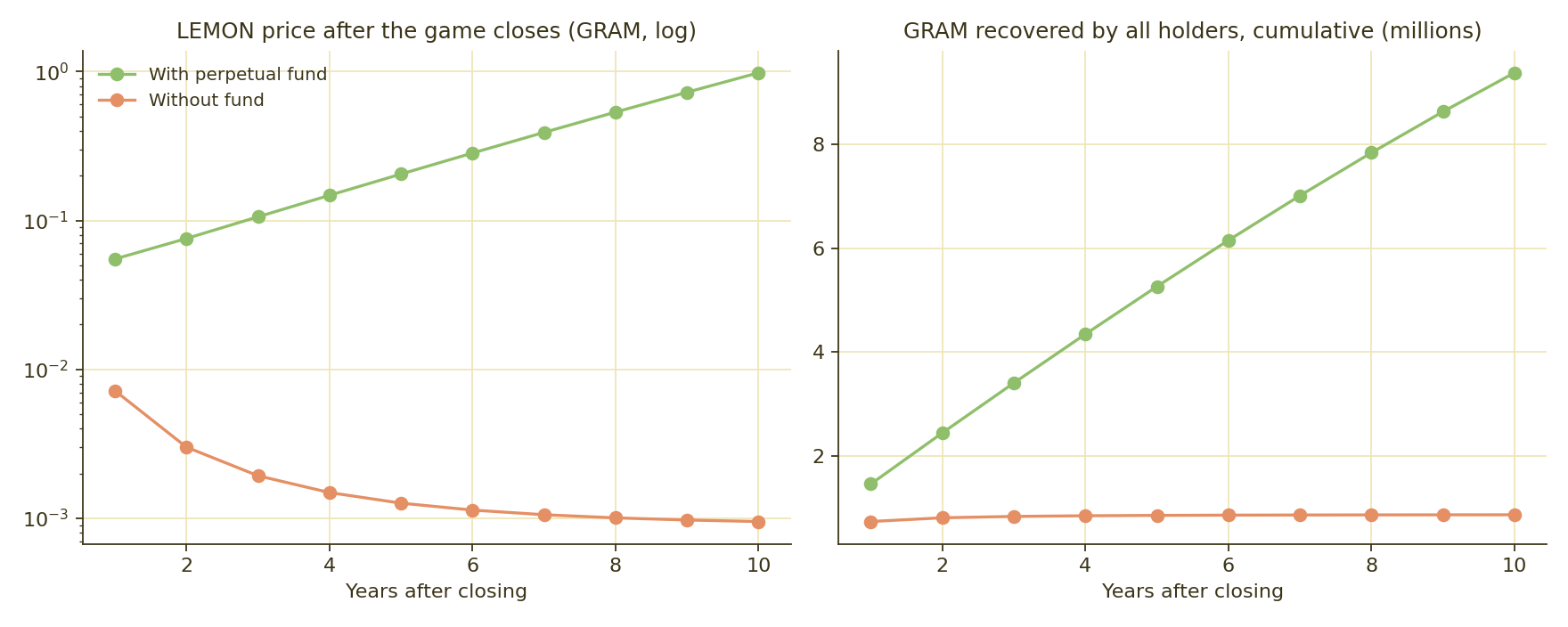
The chart is the "large game" scenario from Projections, closed at the end of year 5 with 74M LEMON in players' hands and a fund of 10.6M GRAM, at a 12% staking yield. Holders sell 30% of what they have left each year. Without the fund the price collapses in the first year and stays there; holders recover 0.86M GRAM in ten years. With the fund, the price bottoms in year one at 0.06 and rises every year after, passing the old ceiling by year five, and holders recover 9.4M GRAM — about 11× as much. The patient holder ends up better than the one who ran first, which is the opposite of how a Ponzi behaves.
For the analytically minded: a perpetual buyback funded by a fund's yield, discounted at that same yield, is worth 90% of the fund. All circulating LEMON together therefore has a floor value on the order of 90% of the fund for a holder who is willing to wait. The market will discount that for risk and time, but it is an anchor computed from a contract balance, not a promise.
About the staking yield. GRAM staking paid 4–6% for years; after the Catchain 2.0 upgrade in spring 2026 it jumped to around 24% and has been settling since (15–21% at the time of writing). The rate floats with how much GRAM is staked network-wide and will keep changing. Our projections use 12% as the base case and show 5% and 20% as sensitivities. We promise nothing above what the providers pay.
Risks, stated plainly. The fund's and the reserve's only way to lose principal is a failure of a staking provider, which is why both are split across two of the most established ones, and why 20% of the reserve is kept as plain GRAM for immediate floor defence. Liquid-staking tokens can trade at a small discount in volatile weeks; the liquid 20% exists so the reserve never has to sell into that.
Emission in practice
The Bank mints LEMON in three situations only, and all three are bounded:
| Situation | Bound |
|---|---|
| Selling LEMON to players when the Bank has no surplus | Only above the band ceiling, only until the price is back at 0.15 |
| Redemption shortfall | ≤ 20% of that month's redemptions |
| Liquidity | Paired with GRAM from direct sales, 10% of each sale |
Everything minted is reported on the stats page against the 100M cap.
What this looks like in numbers
From the five-year simulation (assumptions and full tables in Projections; 12% staking yield):
| Scenario | Active stands, year 5 | Bank balance | Operating reserve | Perpetual fund | LEMON supply | Months with a reduced redemption rate | Team income, year 1 → years 2–5 avg (GRAM/month) |
|---|---|---|---|---|---|---|---|
| Launch then plateau | 3,350 | 369k LEMON | 185k GRAM | 436k GRAM | 3.7M | 0 | 2,500 → 1,700 |
| Hype then decline | 470 | 23k LEMON | 36k GRAM | 286k GRAM | 1.7M | 6, all in year 1 | 3,100 → 560 |
| Large game (~500k stands) | 19,900 | 1.06M LEMON | 2.0M GRAM | 10.6M GRAM | 81M | 0 | 98,000 → 26,000 |
| Large game without the production cap | 504,000 | 0 | 0 from year 1 | 3.4M GRAM | 192M (over cap) | 54 of 60 | 55,000 → 3,200, a dead game |
The last row is the game we did not build.
Which contract enforces what
| Rule | Contract |
|---|---|
| Supply cap 100M, Bank as sole minter | LEMON jetton master |
| Stand price ladder, per-account cap, cycle caps, repairs, retirement | Stand NFT collection + game manager |
| Redemption rate ≤ 100:1, monthly budget, emission bounds | Bank |
| GRAM split 55/25/10/5/5 on every receipt | Treasury router |
| Price band defence, liquidity additions, reserve staking | Operating reserve |
| No principal withdrawal, adaptive daily yield split, buy & burn (vault below 1M supply) | Perpetual fund |
| Round randomness | Off-chain, verifiable by commit-reveal (see The daily round) |
All contracts are verified on-chain and linked from the stats page. The daily game loop (supplies, rounds, SEED balances, experience) runs on our servers; every SEED redemption, every stand sale, every repair and every marketplace trade settles on TON.