A tycoon on TON
Sell lemonade.
Earn SEED.
Keep the town happy.
Buy a stand, tune your recipe to the weather, open for a 60-minute round. A well-run stand returns about +90% on its price over its eleven-month life, and up to double that if you play it really well. Every stand's earnings have a cap you know in advance, and that cap is why the Bank can always pay what it owes you. It's why this game can last for years.
LEMON · supply cap 100,000,000 · no team tokens · price band 0.05–0.15 GRAM (ExTON) · perpetual fund burns daily
- Citizens
- 0
- Cups sold
- 0
- Walked away
- 0
- SEED earned
- 0.0
Change the stand to see the same day with more capacity. Lost cups are the case for equipment.
A day at the stand
The loop is the same every day, and it takes about two minutes of decisions. The order matters, which is why it is numbered.
- step 1Check the weather
Each city rolls a weather. It changes how many citizens come and what they want in the jar.
- step 2Buy supplies in SEED
Lemons, ice, sugar, cups. About 40% of what you sell goes back into supplies, and that is what keeps the Bank solvent.
- step 3Set the formula
Lemon 20–40, ice 5–15, sugar 10–40 per jar. Match the city and the day; happy citizens tip, unhappy ones walk.
- step 4Open for 60 minutes
Citizens per minute come from a hash you can verify. Serve up to capacity. Earn SEED. Gain experience.
Three rules the contracts enforce
We stopped our first version of this game before launch because it was a Ponzi with extra steps. This version is built so the promise holds in code, whether or not the next player shows up.
An average stand ends its eleven-month life about +90% up, and a well-run one close to +188%. It gets there through capped cycles — up to 200% of its price in gross sales, then a half-price major repair, four in all, each paying a little more. Because every cap is known in advance, the Bank can never owe more than it took in.
LEMON trades inside a band in GRAM. Above the ceiling the game sells; below the floor the operating reserve buys. A quarter of every GRAM the game earns goes to that reserve, and it is staked while it waits. The floor is never lowered.
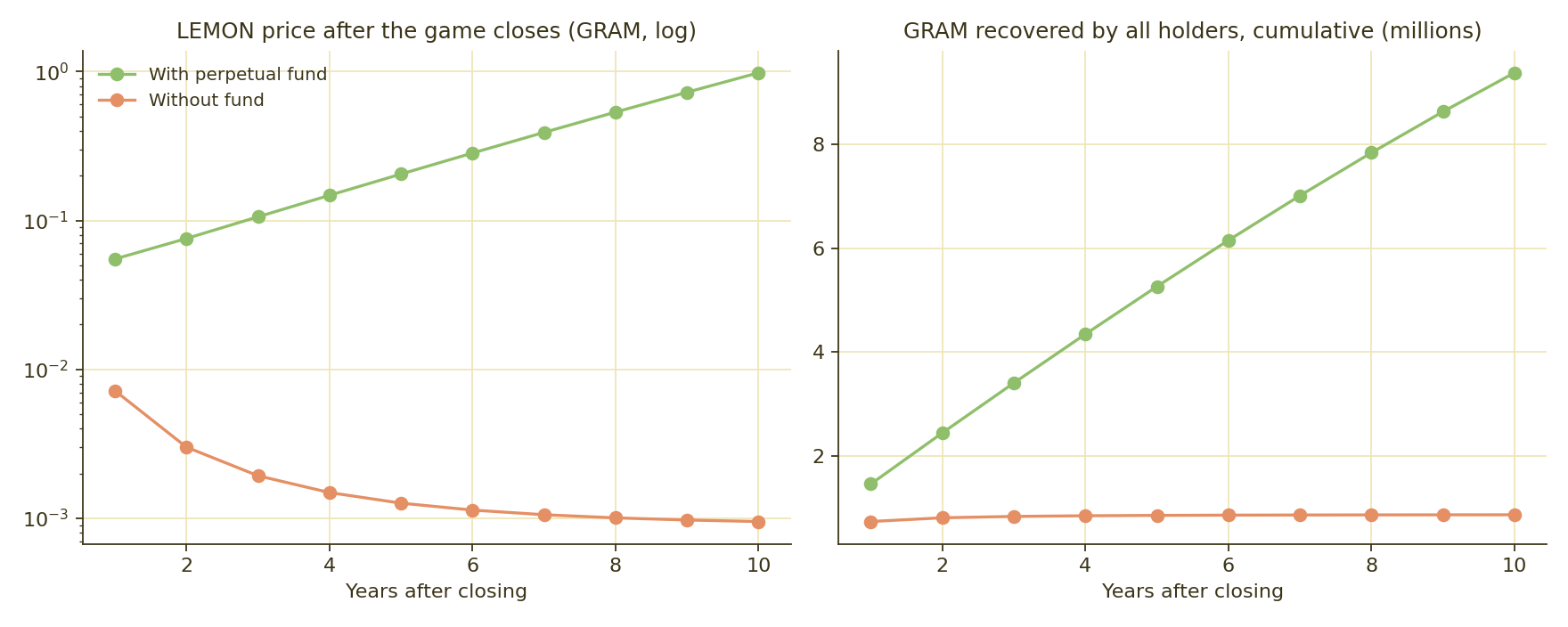
More than half of every GRAM is staked in a contract with no withdrawal function. Its yield buys LEMON on the market and burns it, every day, even if the game shuts down. The team holds no tokens: it is paid 10% of the GRAM the game collects, and a share of the staking yield.
Four cities, four tastes
Your stand is assigned a city. Each pays a base price per cup that drifts down when the city is crowded and up when it is quiet, so spreading out is the winning move and bot farms hurt themselves.
Elegant, busy office crowd
Logo cups earn extra tips
The sweetest tooth in the world
Sugar at the top of the range
It is always sunny
Lots of ice, big volume
Lemon fanatics
Lemon high, sugar low
The documentation
Every number, every rule, every simulation. If something here does not match the chain, tell us; if we cannot explain it, we were wrong.
- IntroductionWhat Lemonade Quest is, who it is for, and the one promise the economy makes.
- How it worksThe full loop from buying LEMON to taking earnings out, in one page.
- CryptoLemonWorldFour cities, four kinds of citizens, and a base price that reacts to how crowded a city is.
- Lemonade standsStand types, the price ladder, production cycles, major repairs, retirement and the marketplace.
- The daily roundSixty minutes, sixty random numbers, and a way for you to check we did not cheat.
- Lemonade formulaThe jar, the ranges, and how the right recipe for the day turns supplies into happy citizens.
- SuppliesWhat a day of selling costs, and why supplies are the backbone of the economy.
- EquipmentMachines, storage and boosts that make a stand faster, with durability so they are spent, not hoarded.
- Levels & zonesExperience, the three zones a stand can work in, and stand levels earned through repairs.
- SEED & LEMONThe soft currency, the token, the exchange between them, and why only playing unlocks the exit.
- TokenomicsSupply, the Bank, the price band, where every GRAM goes, and the perpetual fund that keeps buying LEMON after everything else stops.
- Fair playWhat stops whales, bots and thousand-account farms from taking the game away from players.
- Projections & simulationFive-year simulations of the economy under four player-growth scenarios, with every assumption listed.
- What happens to my money?Plain answers to the questions people should ask any game with a token.
- Roadmap: production assetsThe tiers beyond ten stands — farms, machines, city farms — and the one rule every future asset obeys.